






Carrot Extract (Daucus carota)BBK standing pouch for Carrot ExtractChemical structures of Carrot Extract actives
1/3

Typical colour and texture. Colour varies between batches, and we never boost saturation.

Super Hydro™

Produced with the Super Hydro™ method

Simplisia vs Super Hydro™: extraction separates active compounds from fibre and starch

Super Hydro™ is an extraction method developed by BBK's extract manufacturing team. It draws out the active compounds of natural materials more effectively at a lower concentration. Based on our internal testing, a Super Hydro™ extract at a 2:1 ratio delivers performance comparable to a 5:1 extract from non-standardised producers.

Patent status: The Super Hydro™ method is currently patent pending. Even so, every BBK extract has been produced with this method from the start, so each batch you receive meets a quality standard above the market average.

Latin name
Daucus carota
Form
Powder
Application fields
Powder drinks & cereals, Bakery & confectionery, Natural colour & flavour
Marker compound
beta-karoten
Halal status
Certified
Packaging
Sealed aluminium foil, silica gel, batch numbered label
MOQ
1 kg per material
Documents
Specification always included. CoA on request.

Powder form

Carrot ExtractSuper Hydro™

Daucus carota

HalalRegular3-5dMarker: beta-karoten

Price per kilogram

Trial1-4 kgIDR 718,900
Wholesale5-99 kgIDR 599,000
Brokerage100 kg+IDR 537,000

Prices can move. The final figure is locked in the quote once factory stock is confirmed.

Extract ratio

Filler

Price per kg with this choice: IDR 718,900. Filler choice does not change the price.

Ask First

🚚 Free shipping on orders from IDR 2,000,000

Super Hydro™

Produced with the Super Hydro™ method

Simplisia vs Super Hydro™: extraction separates active compounds from fibre and starch

Super Hydro™ is an extraction method developed by BBK's extract manufacturing team. It draws out the active compounds of natural materials more effectively at a lower concentration. Based on our internal testing, a Super Hydro™ extract at a 2:1 ratio delivers performance comparable to a 5:1 extract from non-standardised producers.

Patent status: The Super Hydro™ method is currently patent pending. Even so, every BBK extract has been produced with this method from the start, so each batch you receive meets a quality standard above the market average.

Latin name
Daucus carota
Form
Powder
Application fields
Powder drinks & cereals, Bakery & confectionery, Natural colour & flavour
Marker compound
beta-karoten
Halal status
Certified
Packaging
Sealed aluminium foil, silica gel, batch numbered label
MOQ
1 kg per material
Documents
Specification always included. CoA on request.

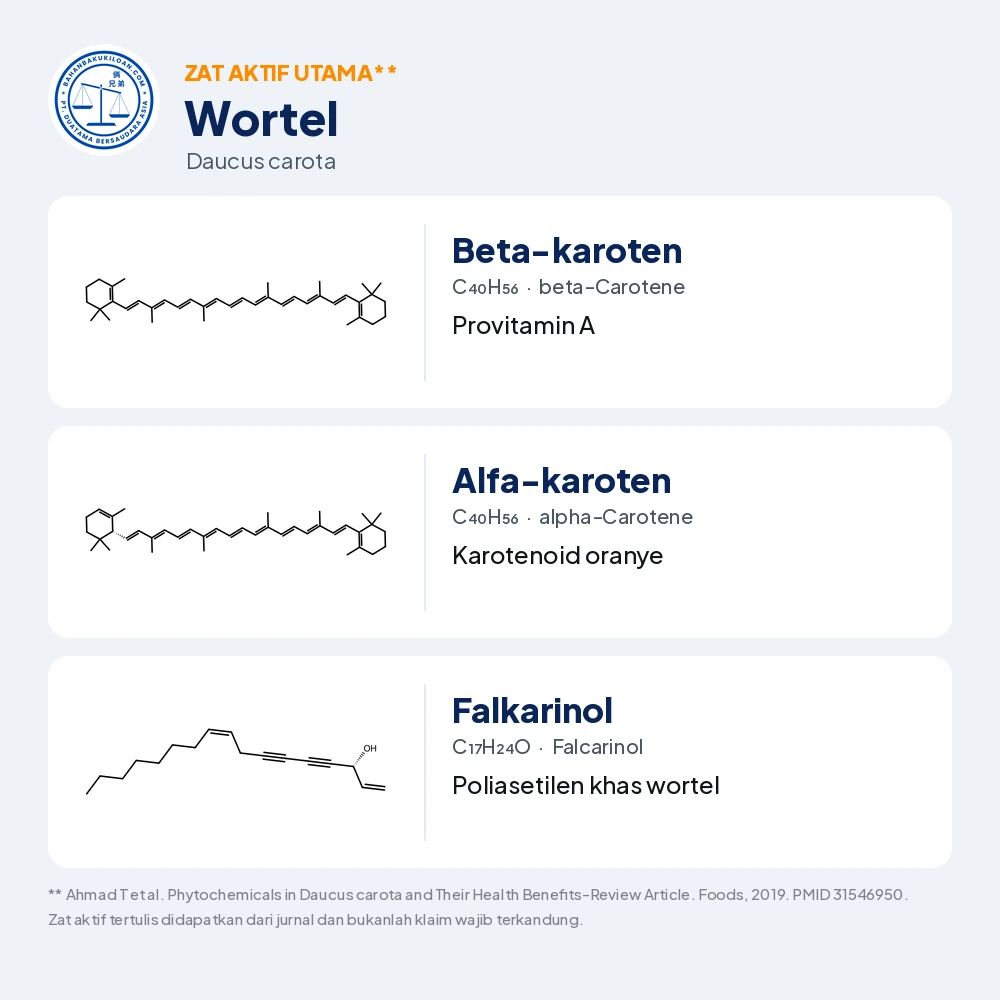
Main active compounds**

  • Beta-karoten · beta-Carotene

    Provitamin A

    C40H56
  • Alfa-karoten · alpha-Carotene

    Orange carotenoid

    C40H56
  • Falkarinol · Falcarinol

    Carrot polyacetylene

    C17H24O

** Ahmad T et al. Phytochemicals in Daucus carota and Their Health Benefits-Review Article. Foods, 2019. PMID 31546950.

Listed actives are taken from journals and are not a guaranteed content claim.

A raw material for further processing, not a ready to consume product. We make no medical claims about this product.

Frequently asked questions

Everything about buying Carrot Extract at Bahanbakukiloan.com

What is the minimum purchase for Carrot Extract?

Starting from 1 kg. Suitable for SMEs, formula testing, research and small-scale production, without having to buy a large factory MOQ.

Does Carrot Extract come with a CoA?

Yes. Every purchase starting from 1 kg includes a free CoA (Certificate of Analysis), with a recorded batch number and sealed 1 kg packaging.

What is Carrot Extract commonly used for?

As a raw material for food, beverage, cosmetic and herbal production. Usage dosage and final product licensing depend on your formula and your product regulations.

Can I pay in installments?

Yes. Installments are available via Kredivo, Home Credit, as well as Mandiri and BCA credit cards.

How long does shipping take?

Jabodetabek (Greater Jakarta) can ship instantly. Outside the city uses fast services such as JNE YES, and overseas via UPS or DHL Express. Free shipping for direct purchases from Rp2.000.000.

Can I get a lower price?

Yes. Send the latest invoice from your current supplier via WhatsApp, and our team will check the best offer for you.

Ask Mas Faiz on WhatsApp

Research & product opportunities

Carrot Extract (Daucus carota): 3 Clinical Studies and Product Opportunities

Carrot is one of the best-known sources of beta-carotene. Human evidence is fairly plentiful, but most of it consists of observational studies on diet, not extract trials. The three studies below help brands understand the benefits, absorption, and claim limits.

Study 1 · Systematic review Very strong evidence

Carrot and carotene and multiple health outcomes: an umbrella review of the evidence.

Yi, Li, Liao, et al. Journal of the science of food and agriculture, 2023.

Study design: Umbrella review of 30 meta-analyses of intervention and observational studies with 26 health outcomes, from 1,329 studies screened.

Key findings
  • Carrot consumption was associated with a lower risk of several types of cancer.
  • Carotene intake was associated with a lower risk of fractures, age-related cataracts, sunburn, and Alzheimer's disease.
  • Serum carotene levels were inversely related to all-cause mortality.
  • The findings are reported as associations from meta-analyses of observational and intervention studies, not evidence of cause and effect.

What it means for your product: A broad reference for education about carrots and carotenes in the diet. Disease associations must not be turned into product claims.

Study 2 · Randomized controlled trial (RCT) Strong evidence

Carotenoids are more bioavailable from papaya than from tomato and carrot in humans: a randomised cross-over study.

Schweiggert, Kopec, Villalobos-Gutierrez, et al. The British journal of nutrition, 2014.

Study design: Randomized crossover trial in sixteen healthy people. Test meals containing raw carrot, tomato, or papaya with matched amounts of beta-carotene and lycopene.

Key findings
  • The bioavailability of beta-carotene from papaya was about three times higher than from carrot and tomato.
  • The bioavailability of beta-carotene from carrot and tomato did not differ significantly.
  • The storage form of carotenoids within the fruit cells is thought to be the main determinant of the difference in absorption.
  • Retinyl esters (a form of vitamin A) were higher after the papaya test meal.

What it means for your product: A formulation lesson: beta-carotene from raw carrot is not easily absorbed. The effect of processing and fat in the formula on absorption needs to be tested on your own product.

Study 3 · Randomized controlled trial (RCT) Strong evidence

Effects of a carrot juice intervention on plasma carotenoids, oxidative stress, and inflammation in overweight breast cancer survivors.

Butalla, Crane, Patil, et al. Nutrition and cancer, 2012.

Study design: Randomized intervention study in sixty-nine overweight breast cancer survivors, drinking 8 ounces of fresh carrot juice (the orange Balero variety or the anthocyanin-rich BetaSweet) per day for 3 weeks.

Key findings
  • Total plasma carotenoids rose by 1.65 umol/L in the BetaSweet group and 1.38 umol/L in the Balero group.
  • The rise in plasma carotenoids was inversely related to the oxidative stress marker 8-iso-PGF (OR: 0.13).
  • There was no difference in results between the two carrot varieties.
  • Inflammatory markers did not change.

What it means for your product: Shows that regular carrot consumption raises blood carotenoid levels within a short time. The participant context is specific, so do not link it to cancer claims.

Business ideas

Sales opportunities

Product formats you can develop with this BBK extract.

See 4 business ideasHide business ideas

Drink powders and vegetable juices

Instant carrot juice, smoothies, or mixed vegetable drinks with a natural orange color.

Natural orange colorant

A replacement for synthetic colors in drinks, noodles, bread, and confectionery with a clean label.

Bakery and children's foods

Biscuits, porridge, and bread with added vegetables for the family segment, stating the beta-carotene content from the CoA.

Provitamin A food fortification

Cereals and drink powders positioned as a source of beta-carotene, following BPOM nutrition claim rules.

Claims you can make

Language guide for B2B and educational materials. Claims on finished product labels and ads must be the ones approved by BPOM at registration.

OK to say

  • Contains carrot extract (Daucus carota) with beta-carotene as the marker compound.
  • Carrot and carotene consumption has been reviewed in an umbrella review summarizing 30 meta-analyses (cite the source).
  • Beta-carotene is a natural orange pigment and provitamin A found in carrots.

Avoid

  • Prevents cancer, cataracts, or Alzheimer's disease.
  • Supports eye health or improves vision, unless that claim is approved by BPOM for your product.
  • Claiming that beta-carotene from the product is easily absorbed without your own product test data.

The main evidence comes from consumption of whole carrots, raw carrots, and fresh juice, not the same extract powder. High-dose beta-carotene in supplement form has been associated with an increased risk of lung cancer in smokers, so avoid high doses for this segment. Excessive consumption can make the skin look yellowish (carotenemia), which is harmless.

Using this research for BPOM registration

  1. Add the three journals above to the literature review or the safety and benefit supporting data in your product dossier.
  2. Attach BBK's specification and per-batch CoA as raw material quality data. The specification always ships with the order; CoA is available on request.
  3. Match your serving size to the doses used in the studies, then confirm final claims with a regulatory consultant or BPOM.

The studies above were not done with BBK products. BBK extracts are made with the Super Hydro™ method, but study results do not automatically apply to your finished product.

References

  1. Yi, Li, Liao, et al. (2023). Carrot and carotene and multiple health outcomes: an umbrella review of the evidence.. Journal of the science of food and agriculture. https://doi.org/10.1002/jsfa.12425
  2. Schweiggert, Kopec, Villalobos-Gutierrez, et al. (2014). Carotenoids are more bioavailable from papaya than from tomato and carrot in humans: a randomised cross-over study.. The British journal of nutrition. https://doi.org/10.1017/S0007114513002596
  3. Butalla, Crane, Patil, et al. (2012). Effects of a carrot juice intervention on plasma carotenoids, oxidative stress, and inflammation in overweight breast cancer survivors.. Nutrition and cancer. https://doi.org/10.1080/01635581.2012.650779

Summaries prepared by the Bahanbakukiloan.com team from journal abstracts indexed in PubMed. This page is educational for businesses and does not replace medical advice or regulatory decisions.

See research on other ingredients →

Often ordered together

See the catalogue
Ask PIA